| Home | Sales | The Beckton Story | Cow Size | Efficiency | Birth Wt & Calving Ease | EPD's | News | Contact Us | Links |
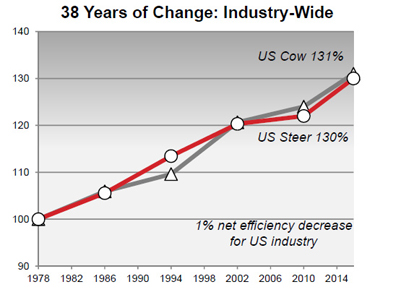
As shown on the left graph below, industry-wide cow size has increased substantially, 25% over the past 28 years. But look at the industry-wide trend in feed use per cow over the same period, shown by the use of hay:
Year |
Tons/Cow |
Percent |
|
Industry Hay Use Source: USDA Econ. Research Service, 2010 is newest available data |
1978 |
1.43 |
100% |
1982 |
1.62 |
113% |
|
1986 |
1.91 |
134% |
|
1990 |
2.00 |
140% |
|
1994 |
1.94 |
136% |
|
1998 |
1.99 |
140% |
|
2002 |
2.08 |
146% |
|
2006 |
2.05 |
143% |
|
2010 |
2.08 |
146% |
Industry-wide, production per cow is up about 22%, but hay consumption per cow has risen 46%.
Why does hay use increase at a faster rate than cow size or prodction per cow? Hay and grain are supplements to the cow's main diet, which is grass, and grass supply is relatively fixed by environment. Each increase in cow feed requirement must be met entirely by supplements, or by a combination of supplement and reduced stocking rate. A small increase in cow feed requirement leads to a reduction in stocking rate or a large increase in higher-cost, supplemental feed needs.
If any gains may have been achieved in the feedlot sector due to increased animal growth, they have been overwhelmed by increased cost of production in the cow-calf sector.
|
|
The graph at left above shows how, for the U.S. cattle industry overall, the increase in average calf weights, as measured by steer slaughter weights, has been directly matched by an increase in average cow weights. (Percentages are based on USDA slaughter weight data for steers and cows respectively, using 1978 as a base year. Data for heifers slaughtered shows an identical trend.) Over 35 years, there has been minimal change in overall cow effieiency.
This graph shows the failure of cross-breeding and composite breeding to do little more than simply increase general cattle size. In the promotion of composites, the impact of retained heterosis on mature weight is too often ignored. Cross-breeding and composites are sold as a free lunch, but they aren't free.
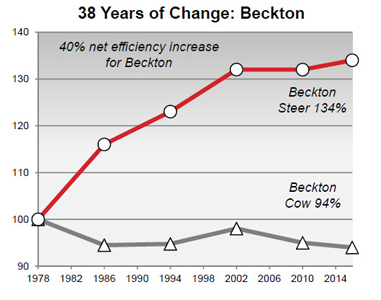
The graph to the right shows Beckton cowherd data over the same time period:
We have accomplished this by selecting for growth, restricting birth weight and cow size creep, and multiplying each incremental change rapidly throughout our entire cowherd and all of our bloodlines. Usually this has meant working within our own bloodlines rather than introducing out-crosses, because the outside genetics for the direction we wanted to go haven't been available. The overall key to success is simply that we have been making small progress in multiple traits, but doing so consistantly over a very long period of time.
|
|
| Home | Sales | The Beckton Story | Cow Size | Efficiency | Birth Wt & Calving Ease | EPD's | News | Contact Us | Links |
Beckton Red Angus home |
Web page © 2014 Elegant Computing Productions Ltd. |